Thursday, April 16, 2015

Anti-Japanism and Yasukuni Shrine

Anti-Japanism, a form of racism manifested with intense prejudice as in an attitude or policy of hatred and hostility toward the Japanese race, became so apparent when U.S. and other Western powers envisaged colonization of Japan more than a century ago. The World War II could be so defined as the war to annihilate the Jews and the Japanese race when we review WWII in view of such a statement as the most famous American hero, Mr. Charles Lindberg made in his diary “What the German has done to the Jew in Europe, we are doing to the Jap in the Pacific. As Germans have defiled themselves by dumping the ashes of human beings into this pit, we have defiled ourselves by bulldozing bodies into shallow, unmarked tropical graves. A long line of such incidents parades before my mind: the story of our Marines firing on unarmed Japanese survivors who swarm ashore on the beach at Midway; the accounts of our machine-gunning prisoners on a Hollandia airstrip; of the Australians pushing captured Japanese soldiers out of the transport planes which were taking them south over the New Guinea mountains; (“The Aussies reported them as committing hara-kiri or ‘resisting’”);------.
After the end of the Greater East Asia War (also called “the Pacific War” in the U.S., etc.), General Douglas MacArthur ignored the Potsdam Declaration and also international laws. Instead, he rampantly issued his own decrees much to the surprise of  the Government of the Imperial Japan. MacArthur’s motive was to whitewash almost all historical events that led to the war between Japan and U.S., so as to revise the history. Dr. Watanabe Shoichi, Professor Emeritus at Sophia University, Tokyo claims that General Douglas MacArthur was the most extreme revisionist when viewed from where Japan stood during the U.S. occupation of Japan.
 In other words, MacArthur’s drive for anti-Japanism culminated when he imposed the current Constitution of Japan and also the outcome of the Tokyo Trials on Japan along with a number of forced changes made to Japan just because Japan lost the war largely dictated by its security, which Dr. Watanabe has stated on the number of occasions.

Mr. Ishihara Shintaro, the then Tokyo Governor stated 4 years ago when the Democratic Party of Japan (DPJ) was in power  “Those guys are not Japanese!” in reply to a question raised  by a reporter “None of the DPJ Cabinet members has visited Yasukuni yet. Why have you visited Yasukuni?.” 

U.S. Forces’ Policy of Not Taking Japanese POWs
Unlike the Great Imperial Japanese Forces took the surrendering enemy soldiers prisoners of war, U.S. Forces had a policy of not taking Japanese POWs and of conniving mistreatment of Japanese POWs, obviously refusing to observe what’s required in the Geneva Convention.
By slaughtering the surrendered or surrendering Japanese soldiers, U.S. Forces had achieved objectives of reducing the burdens to treat them as POWs and at the same time of eliminating the slightest possibility that U. S. Forces might be accused of war crimes committed against them.
U.S. and its allies killed every surrendering or surrendered Japanese soldier whenever possible, except when they filmed the scenes of capturing the surrendering Japanese soldiers to show that they had humanely treated the disarmed soldiers and civilians, so as to strengthen the image that U.S. fought for freedom and justice. They showed no mercy towards Japanese soldiers, whether they were the surrendering ones or not, with the firm conviction that Japanese were less than wild animals.
Just because U.S. won the war, U.S. acted like “the Almighty without a single flaw” under the guise of preserving justice and observing the international laws by opening the Tokyo Trials, in which victors accused losers of war crimes, who had in fact honestly observed the international laws with all their capacity, hoping that the world would understand Japan’s fight for freedom of the Asian race brutally enslaved by the white ruled nations for centuries.
Mr. Charles Lindberg’s statement supports the above. He states in his diary “Our men think nothing of shooting a Japanese prisoner or a soldier attempting to surrender. They treat the Jap with less respect than they would give to an animal, and these acts are condoned by almost everyone. We claim to be fighting for civilization, but the more I see of this war in the Pacific the less right I think we have to claim to be civilized.”  


Tuesday, April 14, 2015

Korean Forces Operated Comfort Stations in Vietnam during the Vietnam War Daily Press Briefing in Washington, DC on March 26, 2015

QUESTION:  Thanks.  I’ve been asked to ask a few questions about this report out of Japan which is based on U.S. archival documents that show Korean forces in Vietnam during the war operated a number of brothels for their troops.  I was wondering if you’ve seen this report.
MR. RATHKE:  I’m familiar – I am aware that there is such a report.  I can’t say that I’ve studied it or read it in its entirety.  But what’s your question?
QUESTION:  I guess – well, first, I was wondering if you can confirm the validity of the documents that the report is based on.
MR. RATHKE:  Well, I’m not in a position to confirm the documents.  I have not reviewed the documents.  I don’t know whether they – where they stem from or they – do they purport to be State Department documents?

QUESTION:  They are letters that were written from U.S. Forces Command during the Vietnam War and they were from the National Archives.
MR. RATHKE:  Well, then I think it would not be this building that’s in a position to speak to those documents.
QUESTION:  Okay.  In terms of the issue that the report talks about, do you see it as an instance of human trafficking?  Do you see a need to investigate it at all?
MR. RATHKE:  Well, we’re aware of the article.  We don’t have any specific comment on the article.  I think our policy on the trafficking of women for sexual purposes remains well-known, and so I don’t have anything to add to that.
QUESTION:  Given that this is an issue that President Park has focused on, including mentioning it prominently in her UNGA address last year, would you like to see an address by the Korean – would you like to see it addressed by the Korean government?

South Korean Prostitutes Demand Abolition of 2004 Anti-Prostitution Law

A group of South Korean prostitutes submitted to the South Korean Constitutional Court a petition to abolish controversial anti-prostitution law enacted in 2004, whose aim is to protect human rights of Korean women said to  have been much abused in the country. 
They argue that prohibition of prostitution violates their fundamental human rights since their sex work is extremely vital to them as a means of income, a way of generating income considered to be better than stealing.
Mr. Nishimura Kohyu, a Japanese journalist comments on their move as follows;
Their claim contains an impending impact on “Comfort Women” dispute widely reported by South Korean government much biased against Japan. Submission of the petition somehow denies that prostitution they refer to is “human trafficking”, of which South Korean government has recently accused Japan after The Asahi Shimbun retracted its stories related to “Korean women coerced into prostitution”. The other day, U.S. government, namely Mr. Daniel R. Russel, Assistant Secretary of State for East Asian and Pacific Affairs, welcome with open arms Prime Minister Abe’s confirmation that comfort women were victims of “human trafficking” in an interview with The Washington Post. And, although U.S. House Minority Leader Ms. Nancy Pelosi, one of those who strongly pushed forward U.S. House Resolution 121 along with Mr. Mike Honda 8 years ago, she didn’t even say a word about “Comfort women” when she met Prime Minister Abe in Japan on April 3.
We wonder what Mr. Russel is going to say about the Korean prostitutes’ claim.


Monday, April 13, 2015

Inseparable Link between Animal Slaughter and Anti-Japan Education in S. Korea 動物虐待と反日教育・火病 と不可分の関係

Koreans brutally slaughter animals (dogs, pheasants, pigs, etc. as imaginary Japanese) whenever they express their anger over something deceptively unfair to them. Their acts are classified as “somatization disorder” peculiar to the Korean race. It is often referred to as 火病 pronounced “Hwabyeong” in Korean language, literally meaning “fire angry”.
It is also defined as “a culture-bound syndrome” many of the Koreans show whenever they confront the situations they perceive to be unfair regardless of what realities unequivocally suggest.

Anti-Japan education is compulsory and at the same time mandatory in South Korea, a newly born state whose national policy is to pursue anti-Japan as it was created on August 15, 1948 by U.S. while strongman General Douglas MacArthur was busy driving a wedge into an internationally recognized amicable unity of Japan and Korea under the 1910 Japan-Korea annexation (during 35 years of which both had cordially and harmoniously shared the same destiny) with Syngman Rhee (who later became the 1st chieftain of South Korea) handpicked by U.S. president Truman, thereby creating an anti-Japan stronghold.

Beheaded Japanese Akita Dogs (as their imaginary enemy) displayed at anti-Japan demonstration
Japanese Akita Dogs better known for "Hachi" in an American film, starring Richard Gere


Sunday, April 12, 2015

Dismantlement of both North and South Korea Means Peace and Stability

To restore true prosperity based on peace and stability the Korean peninsula had once enjoyed under the 1910 Japan-Korea annexation with the enormous assistance provided by Japan although it was as short as 35 years, both North Korea created by the Soviet Union on September 9, 1948 and South Korea by U.S. on August 15, 1948 should be dismantled, albeit almost impossible and demanding to the victors of the Greater East Asia War, with deep remorse over their brutal aggression into Japan including Korea whose annexation was amicably and internationally approved of.
Since we have observed that significance of both Kono statement and Murayama statement issued by two political mavericks have been rapidly eroded in Japan due to their highly questionable credibility, we urge U.S. government to issue a statement such as Obama statement on U.S. aggression into Japan with deep remorse over their brutal acts committed against the Japanese race since 1853 when Commodore Matthew Perry first pointed his gun at Japan. This is only if U.S.G. accepts it.
The annexation was realized, despite reprehensible assassination of Prince Ito Hirobumi, four-time Prime Minister of Japan, the former Resident-General of Korea who had in fact persistently insisted that Korea would become modernized and strong enough to defend itself against the Western (chiefly Russia) and Chinese aggression only if assisted by Japan. Simply, dismantlement of both North and South Korea means one step closer to the unification they have long dreamed of. 
Roosevelt and Truman look so chummy with the Communist Leader Joseph Starling. They are totally responsible for having divided the Korean peninsula into two, thereby destroying the peaceful Korea.


On August 15, 1945, Governor of Korea, General Abe Nobuyuki and Commander-in-Chief, Lieutenant General Kouzuki Yoshio lowered “Rising Sun flag” and hoisted “Korean flag”, thereby initiating the establishment of Korean Nation Preparation Committee and granting Korea autonomy. However, the autonomy granted by Japan on August 15, 1945 didn’t last long as U.S. advanced its forces into southern Korea on September 8, 1945 and nullified  the autonomy by lowering “Korean flag” and hoisting “Rising Sun flag” again.  On September 9, 1945, MacArthur declared that southern Korea would be placed under administration of U.S. forces
Despite the agreement reached at Cairo on December 1, 1943, that “in due course Korea shall become free and independent.”, U.S.A. neglected its promise and divided the Korean peninsula into two. Russian entrance into northern Korea was agreed to, after Yalta, by American military authorities as part of the taking of the surrender of Japanese troops, states E. R. Stettinius, Jr. in his book Roosevelt and the Russians The Yalta Conference. Ensuing consequence of U.S. decision to divide Korea into two was “the most brutal War Korea has ever experienced in its history.  


Dubious U.S.-South Korea Alliance !

12 South Korean high school students visiting Okinawa as part of their extracurricular activities have joined a group of local people protesting Henoko airstrip construction at the gate of U.S. Marine Corps Camp Schwab located in northern Okinawa, Japan, now home to the 4th Marine Regiment that defends Japan in fulfillment of the 1952 commitment. Their Korean teacher aged 47 believes that they have to fight against and stop the planned relocation of Marine Corps Air Station Futenma even if the Government of Japan pushes on with its plan as it is not only a matter of Japan but also of the entire Asia.
South Korea, although considered as one of the most important U.S. allies , has consistently remained as an anti-Japan nation since its abnormal birth of August 15, 1948 because of U.S. direct and deep involvement in creating the environment conducive to anti-Japanism in the East Asia during 6 years and eight months long U.S. occupation of Japan, not including the years U.S. had occupied Ogasawara islands and Okinawa Islands.
70 years have passed since the end of the Greater East Asia War (U.S. and its former allies call it “WWII or the Pacific War”. U.S. forced Japan to use “the Pacific War” during the occupation of Japan. ).
However, South Korea, not to mention its better half (North Korea), ironically speaking, perhaps, never realizes that it has had birth defects requiring the immediate attention before it would collapse.
If it has truly considered itself allied to the United States whose intention is to create tripartite alliance based on trust among Japan-U.S.-South Korea, it would have ceased to act against U.S. interests long ago.

Therefore, considering its apparent anti-Japanism based on forged history, Japan has already given up even the slightest hope that there would be “tripartite” at all.
South Korean high school students show off their Tekondo at the gate of the U.S. Camp Schwab in their protest against Japan’s construction work of Henoko Airstrip. 


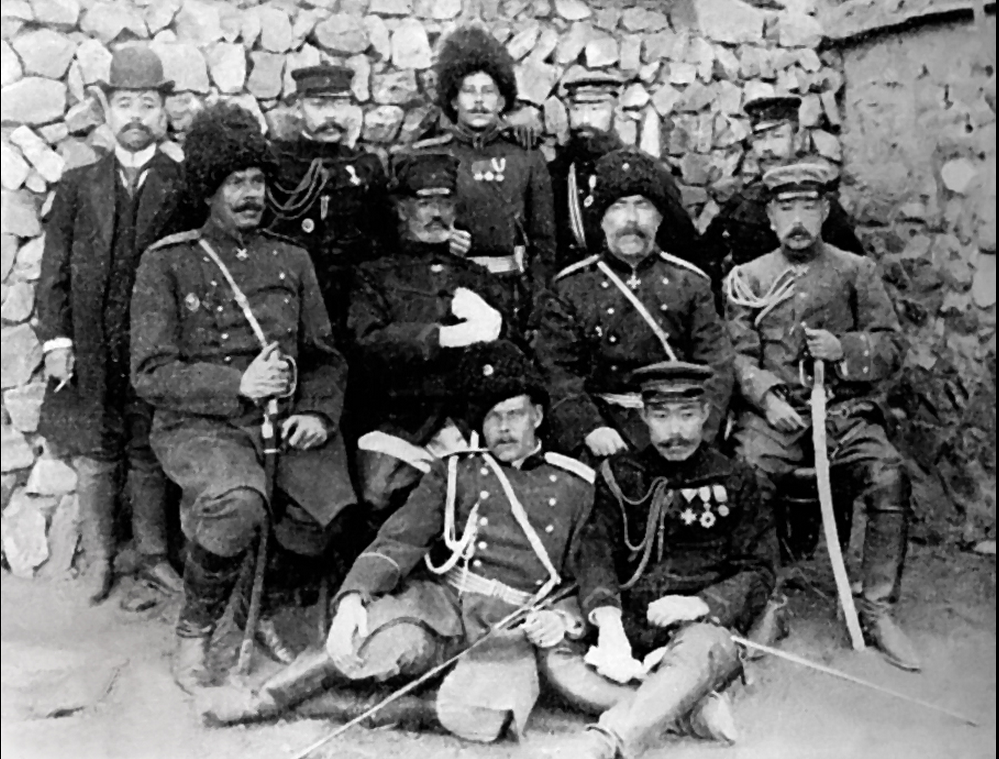
Count Nogi Maresuke, General of the Great Imperial Japanese Army and Baron Anatoly M. Stessel, General of the Russian Imperial Army at Shuishiying Ceasefire Conference

After fierce battle ended, General Nogi as a winner and General Stessel as a loser sit next to each other as friends together with their courageous men
The Meiji Emperor deeply desired that Baron Anatoly M. Stessel, General of the Russian Imperial Army would appear at the conference with his sword, highly honoring and respecting the enemy general as “a great warrior” even though the Russian Imperial Army lost the battle. General Nogi also desired that General Stessel and General Nogi would sit next to each other as “friends” as seen in the photo above. Receiving the report that General Stessel had been sentenced to death by the firing squad at the Russian Court-martial, General Nogi wrote a petition letter to the Russian Emperor, describing his great courage in serving his country in the battlefield. The Russian Emperor then reduced  “death sentence” to  “exile in Siberia”.  This is a good example of Japan’s traditional Samurai Spirit which American General Douglas MacArthur never learned  in his military career.


General Nogi 


General Stessel 
General Nogi standing in the center facing a captured Russian gun crew outside Port Arthur on Jan. 2, 1905
                            水師営の会見Shuishiying was in Lushunkou district, Dalian, Liaoning, China where General Nogi and General Stessel met. 


Japan in East Asia:
Unpromising and Discouraging Future in 19th Century
Japan's modern history and colonization of Asia by the West are inseparably related to each other. There are three major points we should consider as prerequisites for describing a history of modernizing Japan.
1. At the starting point of Japan's modernization, Japan was faced with growing military threats from Great Britain, Russia, France, Netherlands, U.S.A., Germany, etc. while nothing but their battles for domination in Asia prevented them from fully and easily colonizing Asia. Therefore, they were still fighting for supremacy in Asia while Japan was going through a process of modernizing herself, so as to maintain her own independence. ex. Great Britain completed her control over India just 10 years before Meiji Restoration in 1868, Burma in 1886, and Malay peninsula in 1909. France took Vietnam by force in 1887. Netherlands officially colonized Indonesia in 1904. U.S.A. annexed Hawaii in 1898, and seized Philippine the same year. Russia was posing a great threat to Japan in those years.
2. As shown in the above, Japan was completely surrounded by the Western militaristic nations who had strong belief in colonialism for their own benefits. Even China was struggling with difficulties to preserve her own lands since China was in a deteriorating state resulting from its excessive bureaucracy. Korea was just a vassal state of China. Japan vehemently desired that Korea would soon become independent from China and would quickly modernize herself, thereby strengthening Japan's defense against the Western aggression. Either the Western powers or Russia would have colonized the Korean peninsula if nothing was done. The only option left for Japan was to help Korea become independent from China. Japan had much stronger awareness of risks since Japan had experienced long-lasted Samurai period.
3. China and Korea were powerless and helpless. However, they had harbored ungrounded superiority complex over Japan. Ex. Sino-centrism They tended to regard Japan's modernizng efforts as a disturbing factor to Sino-centrism.
Without keeping three points in one's mind, one must not see a history of Japan in relation to what China fabricates and what both Koreas fabricate.
White Peril: Causes of Japan-Russia War in 1904 Viewed from the West in 1905
西洋の視点:日本が日露戦争を戦った本当の理由
"The White Peril in the Far East" by Sidney L. Gulick in 1905 says as follows: The direct cause of the war, then, has been Russia's ambition for Oriental Empire, bearing down in its progress. Manchuria, Korea, and ultimately Japan herself. This process of Russian expansion has been steadfastly pushed, and ruthlessly. It has brought such overwhelming destruction to innocent people in Siberia and Manchuria; it has heaped such insult and such humiliation upon Japan herself and it is so powerful in crushing the national life of the conquered people, that the determination of Japan to save herself from their fate has thrilled the world into sympathy. Two minor causes contributing to the war have been Japan's wholly altruistic motive of good-will to Korea and to China and her desire to stand for honest straightforward diplomacy.
私の蔵書の中にThe White Peril in the Far East 東洋白禍 1905年に出版された本であり、日露戦争の意義を説明している。ニューヨーク、シカゴ、トロント、ロンドンで出版された本だ。 その中に、上記の文書があるので翻訳(仮訳)する。 日露戦争の直接の原因は、ロシアがその発展の過程において、先ず、満州、朝鮮、そして最終的には日本を粉砕して東洋帝国の建設を目指すとする野望である。 このロシアの拡張プロセスは、着実に容赦なく進められて来ている。シベリア、満州の無辜の民に対して圧倒的な破壊をもたらしている。即ち、耐え難いほどの侮辱や屈辱を日本に与えると共に被征服者の国民生活を崩壊させていることからして、日本が、彼等と同様の運命を避けるため必死に自分達自身を救わんとする決意は、世界を戦慄と同情に駆り立てている。 この他に二つの日露戦争勃発の原因がある。それらは、日本の朝鮮及び中国に対する親善的動機であり、又、完全なる他利的な動機である。もう一つは、日本が正直で真直な外交を貫きたいとする願望である。